
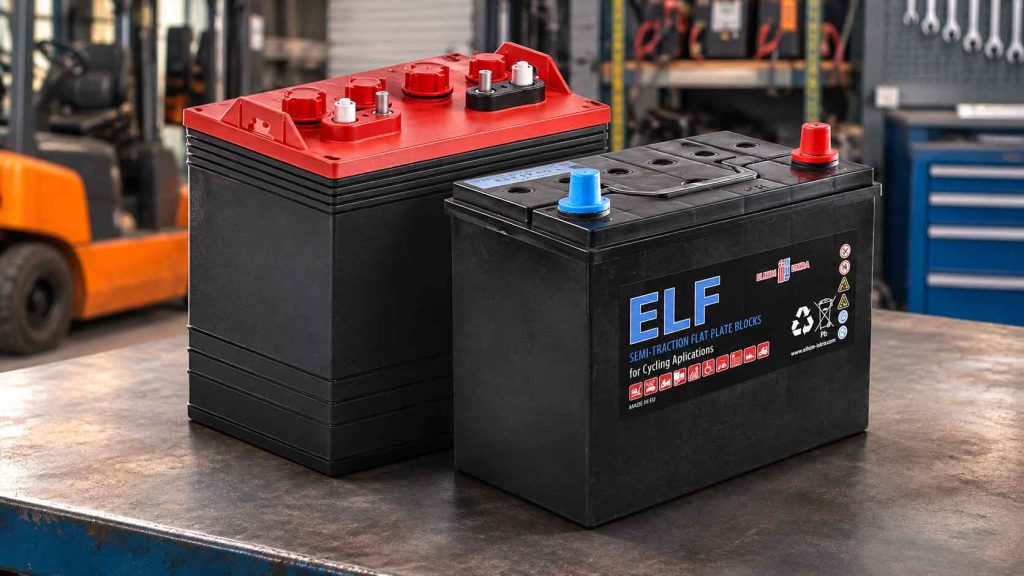
Semi-traction batteries ELT and ELF
A semi-traction battery is a lead-acid monobloc designed to deliver a moderate current over a long period and to withstand deep discharge followed by a full recharge. That sets it apart from both a starter battery and a forklift traction battery. Below are the differences, the two designs, ELT and ELF, and the data to check when replacing one.
Keypoints
- Semi-traction batteries: 6V, 8V and 12V flooded monoblocs for cyclic duty, where the battery is deeply discharged and then fully recharged.
- ELT and ELF: ELT has positive tubular plates and up to 1200 cycles, ELF has pasted flat plates and up to 500 cycles, both per IEC/EN 60254-1 at 25°C.
- When replacing: check voltage, capacity at the same discharge rate, dimensions, weight, and terminal type and position.
Contents
- What a semi-traction battery is
- How it differs from a starter battery
- How it differs from a traction battery
- ELT vs ELF: tubular and flat plates
- ELT models: voltage, capacity, dimensions and weight
- Why C20 and C5 capacity are not compared directly
- What equipment they are designed for
- What to check when replacing
What a semi-traction battery is
A semi-traction battery is a deep-cycle lead-acid battery built as a 6V, 8V or 12V monobloc. It is designed to supply a relatively small, steady current for hours, down to about 80% depth of discharge, and then be recharged.
Why it is called semi-traction
The name reflects its place between the two main classes. It works in cycles like a traction battery, but is built as a compact monobloc, close in shape to a starter battery. It is used where a traction battery made of individual 2V cells would be too large.
Flooded electrolyte
ELT and ELF batteries have a liquid electrolyte. In service, the electrolyte level is monitored and topped up with distilled water according to the manufacturer’s instructions.
How it differs from a starter battery
A starter battery delivers a very high current for a few seconds to crank the engine and almost always stays close to full charge. A semi-traction battery delivers a small current for hours and is deeply discharged. The plates of the two types are designed for opposite duty cycles.
What happens if they are swapped
A starter battery fitted to a machine with cyclic duty loses capacity quickly, because its plates are not designed for regular deep discharge. That is why a scrubber, a platform or a cart needs a deep-cycle battery, not a car battery of the same voltage.
How it differs from a traction battery
A forklift traction battery is assembled from individual 2V cells, such as PzS or PzB, in a common steel tray at 24V, 48V or 80V. A semi-traction battery is a ready-made 6V, 8V or 12V monobloc that is fitted on its own or connected with others.
Scale and capacity
Traction batteries in the catalogue exceed 1000Ah at 24V, while the largest ELT model is 400Ah at 6V. That is why forklifts and heavier warehouse equipment run on traction batteries, and lighter equipment on semi-traction monoblocs. The published traction configurations are in the category lead-acid traction batteries for forklifts.
12V traction or 12V semi-traction
Both types exist at 12V, but they are not interchangeable by default. A 12V traction battery is assembled from 2V cells, while a 12V semi-traction battery is a single monobloc. How voltage affects the choice for forklifts is covered in the article on choosing a traction battery by voltage.
ELT vs ELF: tubular and flat plates
The difference between ELT and ELF lies in the positive plates. ELT has tubular plates and is rated for up to 1200 cycles. ELF has pasted flat plates and is rated for up to 500 cycles. Both figures are per IEC/EN 60254-1 at 25°C.
The product pages state the standard and the test temperature, but not the depth of discharge used in the test. So the two figures serve to compare the designs under the same conditions, not as a promise of a number of cycles in a particular machine.
| Parameter | ELT | ELF |
|---|---|---|
| Positive plate | tubular | pasted, flat |
| Cycle life | up to 1200 | up to 500 |
| Electrolyte | liquid | liquid |
| Capacity in the data sheet | at C20 | at C5 |
What a tubular plate means
In a tubular plate the active material is enclosed in tubes around the conductive spine. This holds it in place through every discharge and charge cycle, so such plates last more cycles than flat pasted ones. The manufacturer also specifies a corrosion-resistant grid with lower internal resistance.
Standby and service life
According to the category description, ELT batteries retain up to 90% of their capacity during standby and have a life of over 5 years before capacity falls to 60%. These values, along with cycle life, are a guide for comparison; actual service life depends on the operating regime.
When ELF is enough
ELF is the more economical option. It suits applications where cycling is less frequent or shallower and up to 500 cycles cover the expected life of the equipment. For intensive daily use, the longer cycle life is the main argument for ELT.
ELT models: voltage, capacity, dimensions and weight
ELT models are published in seven configurations at 6V, 8V and 12V, with a C20 capacity from 115 to 400Ah. The table is based on the product page data; weight is with electrolyte, with a ±5% tolerance.
| Model | Voltage | Capacity C20 | Dimensions, mm | Weight, kg |
|---|---|---|---|---|
| ELT6-175 | 6V | 220Ah | 260 × 180 × 280 | 30.6 |
| ELT6-185 | 6V | 240Ah | 243 × 189 × 277 | 31.5 |
| ELT8-140 | 8V | 180Ah | 260 × 180 × 280 | 32 |
| ELT12-90 | 12V | 115Ah | 343 × 172 × 235 | 34 |
| ELT12-120 | 12V | 140Ah | 343 × 172 × 290 | 41.8 |
| ELT6-280 | 6V | 350Ah | 312 × 180 × 360 | 47.8 |
| ELT6-320 | 6V | 400Ah | 312 × 180 × 410 | 56.1 |
The full data sheet, including box type, layout and terminal type, is on the product page semi-traction batteries ELT 6V-12V.
Weight with and without electrolyte
In the data sheet each model has two weights: without electrolyte and with electrolyte. For handling, installation and the balance of the equipment, use the weight with electrolyte, which is also the value in the table above.
One model, different terminals
ELT6-175 is published in two variants with the same capacity and dimensions but a different terminal type. So when replacing, knowing the model is not enough: the terminal type and position on the old battery must also be checked.
Why the model name does not match the capacity
The number in the model name is not the C20 capacity. ELT6-175 has 220Ah at C20, and ELT12-90 has 115Ah. When replacing, compare the capacity from the table at the stated rate, not the number in the name.
Why C20 and C5 capacity are not compared directly
C20 is the capacity at a 20-hour discharge, C5 at a 5-hour discharge. The same battery delivers more amp-hours at a slower discharge, so a C20 value is higher than a C5 value for the same battery.
What follows for the choice
In the data sheets, ELT is rated at C20 and ELF at C5. The two columns are not compared directly. When replacing, the capacity of the old and the new battery is checked at the same rate, which is printed on the rating plate.
What equipment they are designed for
According to the product description, ELT semi-traction batteries are used in electric stackers and pallet trucks, cleaning machines and industrial sweepers, lifting platforms, electric wheelchairs, caravans and boats, as well as in solar panel and lighting installations.
What these applications have in common
In every case the battery discharges slowly over hours and is then fully recharged. This is the duty a semi-traction battery is designed for, and the reason it is not replaced with a starter battery.
What to check when replacing
When replacing a semi-traction battery, five things are checked. Without them, the new battery may not fit in place or may not connect without modification.
- Nominal block voltage: 6V, 8V or 12V.
- Capacity at the same discharge rate as the old battery.
- Length, width and height in millimetres.
- Weight, especially where the equipment is sensitive to balance.
- Terminal type and position.
When several blocks work together, all are replaced at the same time. A new block connected to old ones works at their condition and quickly levels down to them. The available models are in the category lead-acid semi-traction batteries ELT.
Frequently asked questions
What is the difference between a semi-traction and a traction battery?
A traction battery is assembled from 2V cells in a 24V, 48V or 80V tray for forklifts. A semi-traction battery is a ready-made 6V, 8V or 12V monobloc for lighter equipment in cyclic duty.
Can a semi-traction battery replace a car battery?
It is not designed for that. A car battery delivers a high current for seconds at ignition, while a semi-traction battery delivers a moderate current for hours.
How long does an ELT semi-traction battery last?
The manufacturer states up to 1200 cycles per IEC/EN 60254-1 at 25°C. Actual life depends on depth of discharge, charging regime and maintenance of the electrolyte level.