Lithium-Ion Batteries for Forklifts and Material Handling Equipment
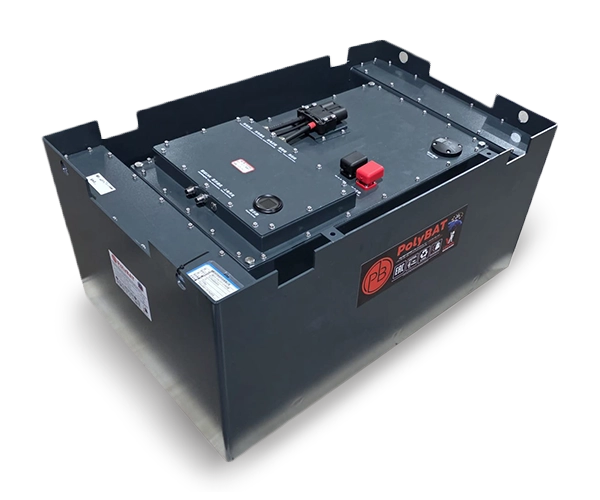
литиево-йонни акумулатори за електрокари
литиево-йонни батерии за електрокари

Lithium-ion technologies are increasingly used in industrial and warehouse equipment because they offer high efficiency, reliability, and easy operation. High-quality lithium-ion batteries for forklifts are a modern solution that requires no maintenance, electrolyte top-ups, or complex servicing procedures. Like modern lithium-ion forklift batteries, they also offer fast charging, allowing charging even during short breaks in the work process.

The technology was developed and designed by Polybet-Export and manufactured in cooperation with Hefei Puleida New Energy Technology Co Ltd.

Advantages of our lithium‑ion batteries for forklifts

Safety

  • Resistance to overheating. LiFePO₄ does not ignite at temperatures up to 270°C, and even in cases of short circuit or overcharging, heating occurs gradually without a sudden temperature spike.
  • Chemical stability. The iron‑phosphate structure is chemically inert and does not release oxygen even when overheated (up to 270–300°C).
  • Built‑in safety measures. High‑quality LiFePO₄ batteries include a BMS (Battery Management System) that prevents overcharging, overheating, and short circuits, while also monitoring battery parameters and using this data to improve safety and extend battery life.

Charging Speed

  • LiFePO₄ batteries can be charged faster than other types of batteries. For example, when using an AC power supply, charging may take 1–3 hours. The actual charging time depends on the battery’s capacity, current, and charging method.
  • The recommended charging current is 0.5C (a current equal to 50% of the nominal capacity).

Environmental friendliness

  • They do not contain toxic heavy metals (cadmium, lead). This reduces the risk of heavy‑metal pollution during production, use, or disposal.
  • Suitable for recycling – the batteries are used to recover valuable base materials such as lithium, iron, and phosphorus, which can be reused in manufacturing.
  • Proper disposal: Batteries are collected in designated containers and then sent for recycling; battery waste must not be disposed of in landfills.
  • We provide battery recycling at the end of their service life.

Factors determining battery life

  • Depth of Discharge (DoD) — the deeper each discharge cycle is, the faster the battery’s lifespan decreases. Ideally, the charge should not fall below 20%.
  • Temperature conditions: Operating at temperatures above 45°C or below –20°C reduces efficiency and accelerates wear. The optimal range is –5°C to +25°C.
  • Deep discharges — discharging the battery below 10–20% of its capacity may lead to progressive capacity loss and severe damage.
  • It is recommended to use chargers provided by Polybet‑Export Ltd, as they are programmed specifically for the PolyBat batteries offered.
  • Avoid constant charging to full capacity (100%) — it is better to maintain the charge level within the 20% to 80% range.

Durability

  • PolyBat LFP batteries come with a 3‑year or 6000‑hour operating warranty (with the option to extend to 6 years or 10,000 operating hours).
  • They can withstand up to 20,000 operating hours at a discharge range of 10% to 90%, as configured in the BMS system.
  • Even with daily use (one cycle per day), the average service life of LFP batteries is around 15 years.
  • Slow capacity degradation. The iron‑phosphate cathode remains structurally stable even after thousands of cycles, without losing its ion‑exchange capacity.
  • High current tolerance. LiFePO₄ can safely operate at charging currents up to 0.5C and discharging currents up to 3C for short periods.

Warranty

The warranty period is 3 years (with the option to extend up to 6 years or 10,000 operating hours) and is ensured thanks to:

  • Top‑quality Grade “A” cells, manufactured by the most proven producers over time: Lishen (lishen.com.ch) and NETC (en.netc.com), guaranteeing long‑lasting and safe operation.
  • Flawless built‑in Battery Management System (BMS), produced by China’s leading manufacturer UDAN, connected via Wi‑Fi and SIM card to the internet, enabling remote monitoring, battery status history tracking, warranty service, and 24/7 communication with the manufacturer.
    The BMS is responsible for performance control, overload and overheating protection, compatibility with the equipment the battery operates on, and battery charging. It regulates the voltage of individual cells, balances them, and thus further extends the battery’s lifespan.
  • Super‑reliable construction and assembly, with five‑stage testing of all components during and after battery assembly. The batteries match the dimensions and weight of the lead‑acid batteries they replace.
  • Certification from authorized organizations.
  • Charging of our lithium‑ion batteries is carried out using chargers manufactured by one of the largest and most reliable charger producers in the world — AIPOWER (en.aipower.com.cn), supplying chargers for major brands such as Heli, BYD, and Hangcha.
  • We also offer post‑warranty service.

Types of Batteries

Comparison: Lithium vs. Lead‑acid Battery

Li-ion Dimensions Lead-acid equivalent
25.6V 125Ah 658 145 560 24V 2PzB 150
25.6V 150Ah 660 150 680 24V 2PzB 200
25.6V 150Ah 610 200 520 24V 2PzSL 180
25.6V 150Ah 645 200 565 24V 3PzSH 210
25.6V 210Ah 790 210 462 24V 3PzSL 240
25.6V 210Ah 620 210 627 24V 3PzS 240
25.6V 210Ah 645 245 565 24V 4PzB 300
25.6V 230Ah 624 281 627 24V 3PzSH 375
25.6V 230Ah 800 210 627 24V 3PzSH 375
25.6V 150Ah 750 170 585 24V 3PzB 225
25.6V 410Ah 930 210 750 24V 3PzSH 465
25.6V 410Ah 625 285 784 24V 3PzSH 465
25.6V 410Ah 827 273 627 24V 4PzSH 500
25.6V 460Ah 827 327 627 24V 5PzSH 625
25.6V 560Ah 830 425 627 24V 7PzSH 840
51.2V 280Ah 970 600 455 48V 5PzSL 400
51.2V 304Ah 1223 282 784 48V 3PzSH 465
51.2V 304Ah 970 600 455 48V 5PzSL 450
51.2V 410Ah 827 519 627 48V 4PzSH 500
51.2V 410Ah 975 610 462 48V 6PzSH 510
51.2V 460Ah 1223 355 784 48V 4PzSH 620
51.2V 460Ah 830 525 784 48V 4PzSH 620
51.2V 460Ah 1005 525 627 48V 5PzSH 625
51.2V 460Ah 827 627 627 48V 5PzSH 625
51.2V 560Ah 1220 425 784 48V 5PzSH 775
51.2V 560Ah 830 738 627 48V 6PzSH 750
83.2V 410Ah 1025 708 627 80V 4PzSH 480
83.2V 460Ah 1025 708 784 80V 4PzSH 620

Final inspection and packaging before dispatch

Assembly of Modules for PolyBat Lithium‑ion Traction Batteries

NETC – Production of Lithium‑ion Cells for PolyBat Batteries

Visit to the UDAN Battery Management System (BMS) Manufacturing Facility

Frequently Asked Questions

Here you will find short answers to the most frequently asked questions regarding the use of lithium‑ion batteries and traction batteries for forklifts. This information will help you make a more informed choice.

What are the main advantages of lithium‑ion batteries?

They feature fast charging, long service life, and easy maintenance.

How long does it take to charge lithium‑ion batteries?

Depending on the model and capacity, charging may take between 1 and 3 hours, which is significantly faster compared to traditional batteries.

Are lithium‑ion batteries suitable for industrial equipment?

Yes, they are widely used in warehouse and industrial equipment due to their reliability and efficiency.

Do lithium‑ion batteries require special maintenance?

No, they are designed to operate without the need for regular servicing or electrolyte refilling.

Where are lithium‑ion batteries used?

Due to their fast charging and long service life, lithium‑ion batteries are widely used in warehouse equipment, forklifts, lifting machines, industrial machinery, and various electric vehicles.

Inquiry Form


POLYBET EXPORT
Privacy Overview

This website uses cookies so that we can provide you with the best user experience possible. Cookie information is stored in your browser and performs functions such as recognising you when you return to our website and helping our team to understand which sections of the website you find most interesting and useful.