
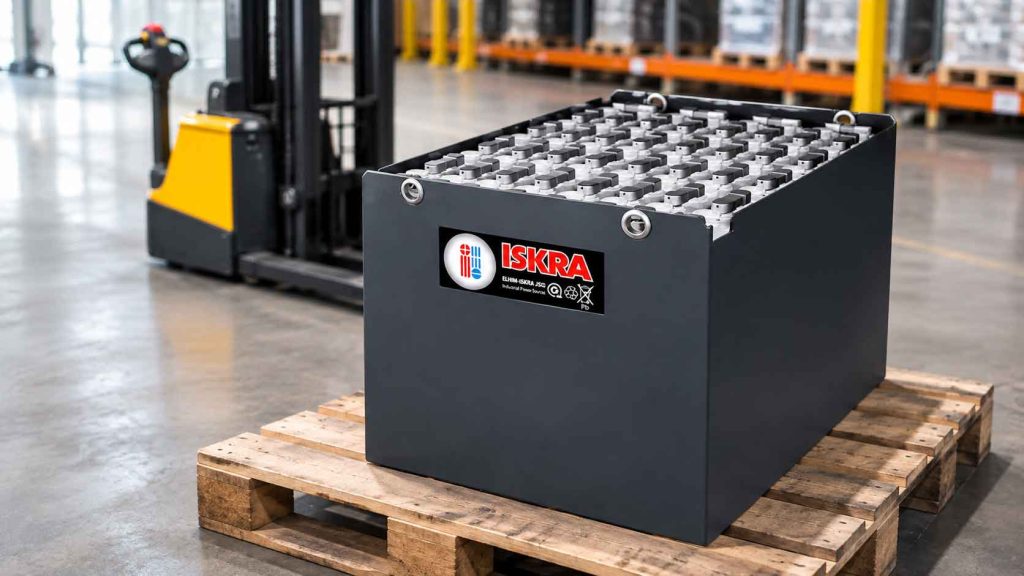
Stacker battery
A stacker battery is chosen by the machine’s voltage and the size of the battery compartment first, and only then by capacity and technology. On stackers and pallet trucks the compartment is usually narrow, so two batteries with the same voltage and capacity may still not be interchangeable. Below are the parameters that decide the choice and the configurations Polybet-Export publishes for 24V equipment.
In short
- Stacker battery: the voltage is read from the rating plate of the machine or of the current battery. 24V is common on stackers, but it is not the only option.
- Battery for a stacker: compartment dimensions, weight, fixing and connector decide whether a configuration is feasible before capacity even comes into play.
- Technology: 24V lead-acid PzB, PzSL and PzSH batteries and PolyBat 25.6V lithium batteries are compared by dimensions and by the lead-acid equivalent published for each lithium configuration.
Contents
- What defines a stacker battery
- How to find the stacker’s voltage
- Why dimensions matter more than capacity
- 24V lead-acid stacker battery
- PolyBat 25.6V lithium battery in narrow formats
- What the lead-acid equivalent shows
- Charger, counterweight and settings
- When renting makes sense
- What to prepare for an inquiry
What defines a stacker battery
A stacker battery is defined by five parameters: nominal voltage, capacity in amp-hours, dimensions, weight and connector type. The technology, lead-acid or lithium, is chosen once these five are clear, because it cannot make up for a mismatch in any of them.
Voltage is not a choice
The voltage is set by the stacker’s electrical system. A battery with a different nominal voltage is not an alternative: it belongs to a different machine. The one practical exception is the 25.6V lithium configuration, which replaces a 24V lead-acid system because a lithium iron phosphate cell is 3.2V, while a lead-acid cell is 2V.
Capacity determines run time
Capacity in amp-hours shows how much energy the battery holds at the same voltage. On stackers it is limited above all by space: more capacity usually means a larger case, and the compartment does not get any bigger.
How to find the stacker’s voltage
The stacker’s voltage is printed on the rating plate of the machine and on the plate of the current battery. If the two differ, the voltage specified by the machine manufacturer takes precedence.
24V, 12V and 48V
24V is a common voltage on hand-operated and pedestrian stackers and on pallet trucks. Smaller equipment may run on 12V, while heavier stackers with a greater lift height are sometimes 48V. So 24V is a reasonable starting assumption for the check, but not a substitute for the rating plate.
The number of cells
A 24V lead-acid traction battery consists of 12 cells of 2V connected in series in a common tray. A PolyBat 25.6V lithium battery consists of 8 cells of 3.2V. The cell count explains why the two technologies have a different nominal voltage for the same machine.
Why dimensions matter more than capacity
The compartment dimensions determine which battery can be fitted at all, before capacity and price are compared. On stackers the compartment is narrow and often tall, so the width of the tray is the parameter that rules out unsuitable configurations fastest.
Standards for 24V batteries
For 24V traction batteries with series L cells, dimensions, weight and design are covered by DIN 43535, while the dimensions of the cells themselves follow DIN EN 60254-2. The standard provides a common framework, but the actual tray depends on the machine manufacturer, so the compartment is measured on site.
How to measure the compartment
Measure the compartment from the inside: length, width and height in millimetres, at the narrowest point. Add the clearance above the battery needed for the connector and cable, and, with a hinged cover, for closing it. It also helps to measure the current tray, because it shows what has already fitted without problems.
Weight and fixing
The battery’s weight is part of the stacker’s design, and the fixing in the compartment should leave no free play. That is why an inquiry should state the weight of the current battery, if it is on the rating plate, together with the internal dimensions of the compartment.
24V lead-acid stacker battery
24V lead-acid traction batteries are available in three series: PzB, PzSL and PzSH. The table lists the 24V configurations published in the Polybet-Export catalogue, with prices in EUR excluding VAT and including the eco fee. Prices are as of November 2026; current figures are in the category.
| Series | Model | Capacity | Price (EUR) |
|---|---|---|---|
| PzB | 2PzB | 150Ah | 578 |
| PzB | 2PzB | 200Ah | 709 |
| PzB | 3PzB | 225Ah | 799 |
| PzB | 3PzB | 300Ah | 1018 |
| PzSL | 2PzSL | 180Ah | 664 |
| PzSH | 2PzSH | 210Ah | 716 |
The full tables by voltage and capacity, including larger 24V configurations up to 1120Ah, are in the category lead-acid traction batteries for forklifts and stackers.
When lead-acid is the logical choice
In single-shift operation with enough time for a full charge between shifts, a lead-acid battery remains a sensible choice. It needs topping up with distilled water and a correct charging regime, but the configuration costs less.
PolyBat 25.6V lithium battery in narrow formats
PolyBat 25.6V lithium batteries are published in several formats for the same capacity, precisely because machine compartments differ. The table shows the configurations up to 230Ah with a width of up to 281 mm, as published in the catalogue, together with the lead-acid equivalent for each.
| Configuration | Dimensions, mm | Lead-acid equivalent |
|---|---|---|
| 25.6V 125Ah | 658 × 145 × 560 | 24V 2PzB 150 |
| 25.6V 150Ah | 660 × 150 × 680 | 24V 2PzB 200 |
| 25.6V 150Ah | 750 × 170 × 585 | 24V 3PzB 225 |
| 25.6V 150Ah | 610 × 200 × 520 | 24V 2PzSL 180 |
| 25.6V 150Ah | 645 × 200 × 565 | 24V 3PzSH 210 |
| 25.6V 210Ah | 790 × 210 × 462 | 24V 3PzSL 240 |
| 25.6V 210Ah | 620 × 210 × 627 | 24V 3PzS 240 |
| 25.6V 230Ah | 800 × 210 × 627 | 24V 3PzSH 375 |
| 25.6V 230Ah | 624 × 281 × 627 | 24V 3PzSH 375 |
The configurations in the table are taken from the Polybet-Export catalogue. The general design, safety features and warranty terms of the PolyBat range, without a breakdown by model, are described on the product page PolyBat LiFePO4 traction battery.
Why one capacity comes in several formats
In the table, the 150Ah capacity is published in four different formats, from 660 × 150 × 680 to 610 × 200 × 520 mm. The reason is that machine compartments vary more than the energy the machines need. So the choice starts with the format that fits, not with the capacity.
What a lithium battery brings to a stacker
A lithium battery needs no water top-ups and no equalising charges. LiFePO4 cells tolerate partial charging, so the stacker can be opportunity-charged during breaks in the working day. PolyBat batteries carry a warranty of 3 years or 6000 operating hours.
What the lead-acid equivalent shows
The lead-acid equivalent shows which 24V lead-acid battery each lithium configuration is matched against. It is a guide for preliminary selection, not proof that a given configuration suits a given stacker.
Why the amp-hours differ
In the table, 25.6V 125Ah is matched against 24V 2PzB 150Ah. Nominal amp-hours of the two technologies are not compared one to one, because usable energy depends both on voltage and on the permissible discharge range.
What is checked before an order
Before an order, the compartment dimensions, weight, fixing, connector and the voltage range the machine accepts are checked. This check is part of selecting the configuration, not work on the machine after delivery.
Charger, counterweight and settings
The chargers Polybet-Export supplies with PolyBat batteries come programmed for the management system of the respective pack, so no settings are made on site. The required counterweight is built into the lithium pack itself, relative to the lead-acid equivalent.
The charger for a lead-acid battery
With a lead-acid battery, the charger is chosen according to the voltage and capacity of the new battery. An old charger sized for a smaller capacity will not charge it fully and shortens the life of the new battery.
When renting makes sense
Renting a traction battery makes sense under seasonal peaks or while a new configuration is being prepared, if the stacker cannot stop. Availability and suitability for the specific machine are confirmed through a separate inquiry for traction battery rental.
What to prepare for an inquiry
For an accurate quote for a stacker battery, prepare the following:
- Make, model and year of the stacker.
- Nominal voltage and capacity from the rating plate of the current battery.
- Internal dimensions of the compartment in millimetres.
- Weight of the current battery, if stated.
- A photo of the connector and of the rating plate.
- Number of shifts and the usual breaks in the working day.
If you are unsure how voltage affects the choice, the differences between 12V, 24V, 48V and 80V are covered in the article on choosing a traction battery by voltage. Lithium configurations and the full equivalence table are in the category lithium-ion batteries for forklifts and stackers.
Frequently asked questions
What battery does a stacker need?
A battery with the same nominal voltage as the machine, with dimensions that fit the compartment, and with suitable weight and connector. The technology, lead-acid or lithium, is chosen once these parameters are clear.
Can a 25.6V lithium battery replace a 24V lead-acid battery in a stacker?
25.6V is the lithium equivalent of a 24V system. Whether a specific configuration suits a specific stacker is determined when dimensions, weight, fixing and connector are checked before the order.
How much does a stacker battery cost?
According to the catalogue as of November 2026, the published 24V lead-acid configurations start at EUR 578 excluding VAT for a 2PzB 150Ah. The price depends on the series, the capacity and the dimensions the compartment allows.