
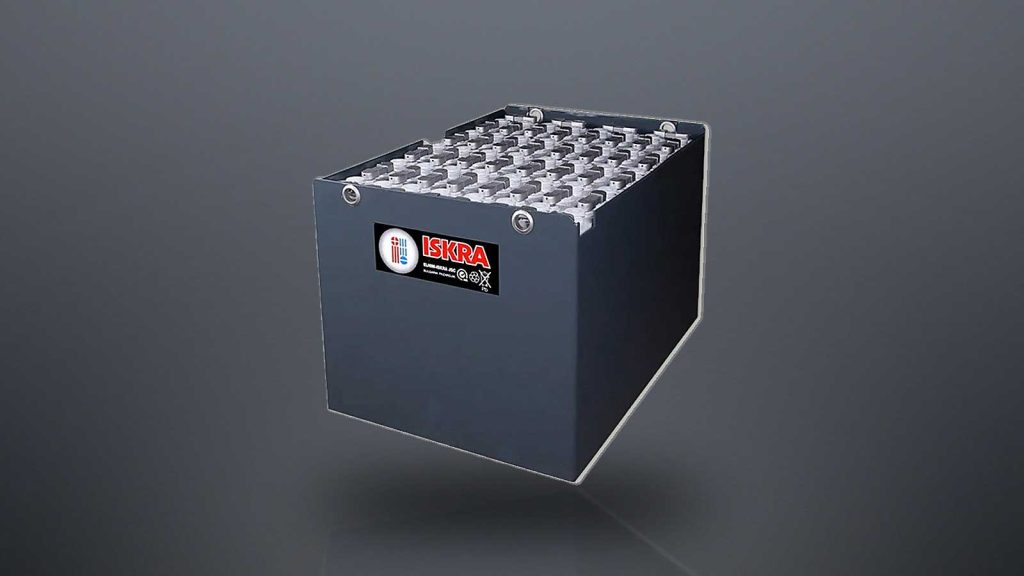
Forklift traction battery replacement
The need to replace a traction battery usually shows up as a shorter working time on the forklift. The cause can sit in the battery, in the charger or in a changed duty cycle. This guide covers the signs, the measurements that settle the question and the data needed for a suitable replacement.
In short
- First sign that a traction battery needs replacing: the forklift runs for less time under comparable load. Check the charger as well.
- Measurement: a capacity test plus cell-by-cell checks. The 80% of rated capacity threshold is a reference point taken from the cycle endurance test in IEC/EN 60254-1, not an automatic verdict.
- Next step: servicing, a rented forklift battery or a new configuration, depending on the result and on your shift schedule.
Contents
- How to tell the battery is near the end of its life
- Why capacity drops and how the problem develops
- Observations that are not enough on their own
- Measurements that give a real answer
- How the 80% capacity reference point is used
- Servicing, rental or a new battery
- What data a supplier needs for a suitable replacement
- Sample configurations and indicative prices
- What happens to the old battery
- Common mistakes during replacement
How to tell the battery is near the end of its life
The most reliable early sign is a shorter working shift under the same load. If the forklift used to cover a full shift and now stops two hours earlier on the same routes with the same loads, there is good reason to have the capacity checked.
The shift ends earlier
Compare like with like. Winter operation, a new operator or a change of route will also shorten a shift. If the workload is steady and the time to discharge falls by 20% or more, the battery is one of the likely causes.
The battery runs unusually warm
Unusual heating towards the end of charging is a reason to check both the battery and the charger. Several causes are possible: increased internal resistance in the cells, a wrong charge profile or overcharging. Temperature alone cannot establish sulfation or capacity loss, so the observation is confirmed by measurement.
Electrolyte level drops faster
More frequent topping up with distilled water means more intensive gassing. That points to overcharging or to aging cells, but on its own it does not identify the cause. For PzS cells the manufacturer states low water consumption, so a clear increase over the usual interval is a reason to check the charge regime.
Why capacity drops and how the problem develops
Capacity in a lead-acid traction battery falls because of three processes that build up over the years: sulfation, loss of active material and imbalance between cells. None of them starts suddenly.
Sulfation from incomplete charging
When a battery is regularly charged only partially or left discharged between shifts, coarse lead sulfate crystals form on the plates. They do not dissolve during normal charging and permanently remove part of the capacity.
Loss of active material from the plates
With every cycle, part of the active material on the positive plates sheds. This is normal wear and it sets the designed service life: for PzS and PzB models the manufacturer states up to 1500 working cycles under correct operation.
Imbalance between individual cells
A battery performs only as well as its weakest cell. One cell with a dropped voltage pulls down the whole string and is often mistaken for a general fault, although the problem is local.
Observations that are not enough on their own
An operator’s impression and a single reading are not grounds for replacing a battery worth several thousand euros. Both give direction, not an answer.
The operator’s impression
The operator notices the change first, but cannot separate a worn battery from a wrong charge regime, a flat tire or a heavier load. The signal is a reason to check, not a conclusion.
A single open-circuit voltage reading
Open-circuit voltage shows the state of charge at that moment, not the capacity. A battery that has lost 30% of its capacity can still read a perfectly normal voltage right after charging.
Measurements that give a real answer
The condition of a traction battery is established with a capacity test at a controlled discharge current, supported by measurements on every cell. Without those two, any assessment remains a guess.
Capacity test
The battery is discharged at a rated current down to the cut-off voltage, and the amp-hours delivered are compared with the rated figure. The result is expressed as a percentage of rated capacity and is a direct measure of what the battery delivered during the test.
Specific gravity and voltage readings
Cell-by-cell measurement shows whether the drop is general or comes from a few weak cells. A difference in electrolyte specific gravity between cells points to sulfation or to acid stratification.
Charger records
Modern chargers keep a history of cycles, charge returned and interrupted charges. Those records often explain why a battery aged faster than expected, and they show whether the same problem will repeat with a new one.
How the 80% capacity reference point is used
In the cycle endurance test of IEC/EN 60254-1, a drop below 80% of rated capacity marks the end of the test. In practice this is a reference point rather than a verdict: the decision to replace depends on the shift length required, on the condition of individual cells and on operating conditions.
With a lower measured capacity the battery may no longer cover the working time needed. That does not imply the same rate of wear on every machine, since load, charging and maintenance all play a part.
Servicing, rental or a new battery
The three options are chosen according to the capacity test result and to how much time you have. These are the boundaries within which each one is reasonable.
When servicing is enough
If the test shows sufficient capacity for the duty cycle, the cause is often outside the plates themselves: dirty or corroded terminals, loose connections, a wrong charge profile or a skipped equalizing charge. Each of those is corrected without replacement. A single weak cell, however, is not cured by an equalizing charge and is assessed separately.
When rental makes more sense
Rental can be the answer during seasonal peaks or a planned replacement. Check availability and the fit of a rented industrial battery with the specific machine.
When a new battery is the right call
A new battery is considered when the measured capacity no longer covers the working schedule, when there is serious physical damage, or when the duty cycle is about to change. Even below 80%, the result is weighed together with the technical condition and the needs of the machine.
What data a supplier needs for a suitable replacement
An accurate quotation for a traction battery requires six pieces of data. Without them every offer is approximate and risks not fitting the compartment.
Nominal voltage and capacity
Voltage is read from the battery nameplate: 12V, 24V, 36V, 48V, 72V or 80V. Capacity is stated in amp-hours at the five-hour discharge rate, which is the reference for traction batteries.
Dimensions and weight
Length, width and height of the tray must match the machine’s compartment, and on many forklifts the battery weight forms part of the balance. Cell dimensions in series L are standardized in DIN EN 60254-2, while DIN 43531 and DIN 43535 describe dimensions, weights and design for 48V and 24V traction batteries built with such cells. The compartment and the restraint are measured on site.
Connector type and cable exit
The connector and the side the cable exits from decide whether the battery can be plugged in without modification. This detail is not on the nameplate and is the one most often missed, and reworking it costs time. The quickest fix is a photo of the existing connector and terminals attached to the inquiry.
Machine model and duty cycle
The forklift or stacker model allows the specific configuration to be cross-checked. The duty cycle, whether one, two or three shifts, matters for sizing the energy required.
Sample configurations and indicative prices
As examples for warehouse equipment, the table includes several 24V configurations of different capacity. The figures are real catalog models. Prices are in EUR, excluding VAT, including ECO fee.
| Voltage | Model | Capacity | Price (EUR) |
|---|---|---|---|
| 24V | 3PzB | 300Ah | 1018 |
| 24V | 4PzSL | 440Ah | 1267 |
| 24V | 4PzSH | 620Ah | 1634 |
| 48V | 5PzSL | 400Ah | 2086 |
| 80V | 5PzSH | 525Ah | 4751 |
Full rows by voltage and capacity are in the section on lead-acid traction batteries for forklifts and stackers. What drives the final figure is covered separately in the article on traction battery price.
What happens to the old battery
A traction battery taken out of service goes for recycling and cannot be discarded as ordinary waste. Collection and treatment of industrial batteries in the European Union are governed by Regulation (EU) 2023/1542.
The terms for handing over the old battery and any buy-back value are agreed with the supplier. Check those terms together with the quotation for the new configuration.
Common mistakes during replacement
Most problems with a traction battery replacement do not come from the quality of the new unit but from three decisions taken too quickly.
Ordering on voltage and capacity alone
Two 24V 300Ah batteries can have different dimensions and different weights. Without the tray dimensions there is a real risk the new battery will not fit the compartment.
Keeping the old charger without checking it
A charger is selected according to the capacity and the type of battery. An old charger sized for a smaller capacity will not charge fully, and an unsuitable characteristic shortens the life of the new battery. Suitable models are in the battery chargers category.
Waiting for a complete failure
Low measured capacity shortens the shift and forces unplanned charging, while manufacturing and delivering a new configuration takes time. Check the condition while the machine is still working, so servicing or replacement is planned around the warehouse schedule rather than around the moment of failure.
Frequently asked questions
How many years does a forklift traction battery last?
It depends on depth of discharge, charging and maintenance. For some PzS and PzB models the manufacturer states up to 1500 cycles under defined conditions, which is not a guaranteed term in years.
Can a single cell be replaced instead of the whole battery?
Technically yes, and it makes sense on a young battery with one defective cell. On a heavily worn battery the benefit of replacing a single cell can be limited, and a specialist assesses the condition of the remaining cells.
How can I check capacity without taking the machine out for a full day?
Voltage and specific gravity readings per cell are taken between shifts and give a good first assessment. A full capacity test requires a controlled discharge and recharge, so it is scheduled for a non-working day or carried out on a spare battery.