
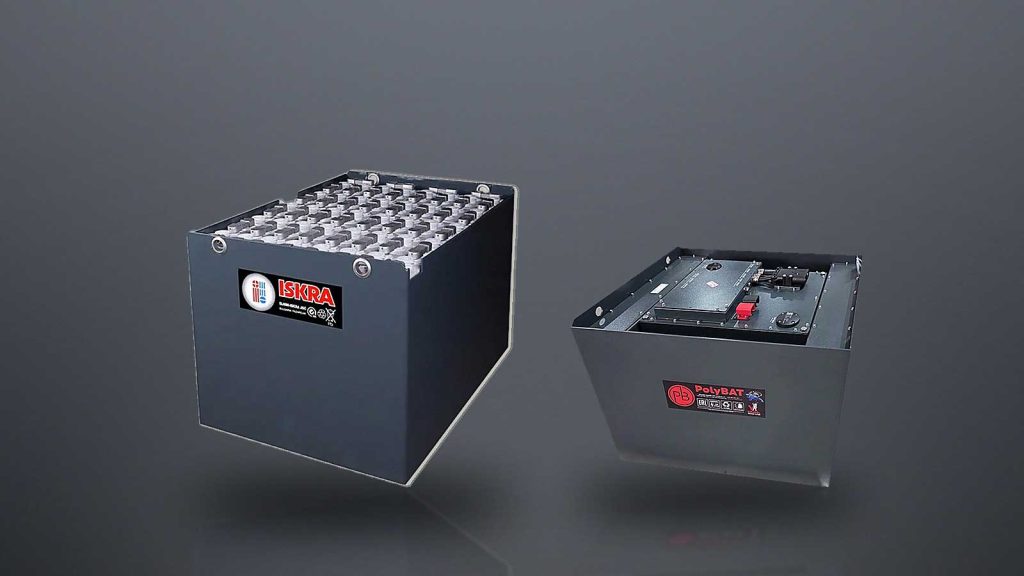
Replacing a lead-acid with a lithium battery on a forklift
A lithium battery for a forklift is not ordered by the nominal voltage of the old one. The two technologies do not share nominal voltages, capacity cannot be compared directly, and the dimensions and connector decide whether the swap is feasible at all. These are the checks that have to pass before an order is signed.
In short
- Voltage: a lithium battery for a forklift in 25.6V, 51.2V and 83.2V configurations is matched against 24V, 48V and 80V lead-acid systems after the machine has been checked.
- Compatibility: verify dimensions, actual weight, connector, charger and the forklift’s electronics.
- Economics: opportunity charging is useful across several shifts, but the calculation depends on the schedule and on the full cost of the changeover.
Contents
- When switching to lithium makes sense
- Why 24V becomes 25.6V
- Capacity: why amp-hours are not compared directly
- Dimensions, weight and machine balance
- What the equivalence table shows and what it does not prove
- Connector, cable and terminal position
- How the charger is assessed
- The BMS and its link to the machine
- How shift organization changes
- What data an inquiry needs
When switching to lithium makes sense
Across several shifts with breaks available for opportunity charging, a lithium battery can deliver a real operational gain. On single-shift work the economic comparison usually looks different. It depends on the price of the battery and the charger, on servicing costs and on the actual schedule.
Two and three-shift operation
LiFePO4 batteries tolerate partial charging without the loss of service life a lead-acid battery suffers from incomplete charges. That makes charging during a lunch break practical. Whether it removes the need for a second battery depends on the permissible charge current, on the length of the breaks and on the actual energy consumed per shift.
Warehouses with limited charging space
The charging point for a lithium battery is usually close to the working area rather than in a separate room, because charging happens in short intervals within the shift. The specific requirements for that location come from the pack manufacturer, from the available connected power and from site safety rules, so they are confirmed before ordering.
When the switch is not justified
For short daily operation or where charging power is limited, the lead-acid option still deserves a comparison. In those cases the comparison starts from lead-acid traction batteries.
Why 24V becomes 25.6V
The two technologies differ in nominal voltage because their cells differ. A lead-acid cell is 2V, while a lithium iron phosphate cell is 3.2V. Eight LiFePO4 cells give 25.6V, which is the closest working equivalent to a 24V battery.
Voltage equivalents
| Lead-acid | Lithium LiFePO4 | Cells |
|---|---|---|
| 24V | 25.6V | 8 |
| 48V | 51.2V | 16 |
| 80V | 83.2V | 26 |
Why the difference matters
Voltage behaves differently under load in the two technologies. Before a swap, confirm that the controller and the power electronics of the machine accept the full working range of the lithium pack, including at full charge.
Capacity: why amp-hours are not compared directly
Nominal amp-hours on their own do not indicate running time. Compare the voltage, the usable energy within the window set by the BMS and the actual duty cycle of the machine.
What this means in practice
The catalog, for example, matches a 24V 2PzB 150Ah battery with a 25.6V 125Ah lithium configuration. That is a starting point for preliminary selection; expected running time is calculated for the specific cycle.
Where the comparison goes wrong
If the choice is made purely on the old amp-hour figure, the new configuration comes out either unnecessarily large or short of the schedule. Calculate the energy required per shift from the actual workload, and only then compare configurations.
Dimensions, weight and machine balance
A swap requires checking both the compartment dimensions and the battery weight the machine needs. A given configuration may already carry a suitable weight; the need for ballast is determined from the machine data.
Compartment dimensions
Length, width and height are measured from the actual compartment, not copied from the nameplate of the old battery. The catalog states all three dimensions for every lithium configuration so they can be verified in advance.
Weight as part of the design
On many forklifts the battery contributes to the balance of the machine. Compare the actual weight of the finished pack with the manufacturer’s requirements, and specify suitable ballast where it is needed.
Look up the permissible battery weight range in the machine documentation. Compare it with the weight of the completed pack, including the tray and any ballast. Where reliable information is missing, the supplier should verify the configuration against the exact model. Changes to balance or to the restraint are planned before delivery.
Restraint inside the compartment
A pack that is smaller in volume has to be secured so it cannot move during operation. Free play in the compartment loosens the terminals and wears the cable.
What the equivalence table shows and what it does not prove
A table matching lithium with lead-acid batteries is a guide for selection, not a guarantee of compatibility. It shows which lithium configuration has been matched against a given lead-acid model and in what dimensions it is offered.
What you can take from it
You can narrow the choice to two or three configurations and check whether their dimensions fit the compartment. The full comparison by voltage, capacity and dimensions is in the section on lithium-ion batteries for forklifts.
What it does not settle
The table says nothing about the connector, the charger, the ballast or whether the machine’s electronics will accept a lithium pack. Those four are verified separately for each individual forklift.
Connector, cable and terminal position
The connector, the cable length and the side it exits from have to match the machine. A mismatch means rework, which costs time and sometimes changes the price significantly.
What gets checked
- connector type and size;
- polarity and position of the positive and negative terminals;
- cable length from the battery to the connector;
- exit side relative to the compartment.
Why it gets missed
The connector is not on the battery nameplate and does not appear among the standard parameters. The fastest way to avoid an error is a photo of the existing connector and terminals attached to the inquiry.
How the charger is assessed
The charger has to support the profile, the voltage and the communication required by the specific lithium battery. Compatibility of an existing charger is confirmed by the supplier before it is used.
What determines the choice
A charger is selected by pack voltage, by permissible charge current and by the charging time you want. Where opportunity charging is planned, the permissible current and the available power decide how much of each break can actually be used.
Single-phase or three-phase
Single-phase units are generally enough for smaller packs and for overnight charging. Where the aim is fast opportunity charging of a 51.2V or 83.2V pack, the power required normally points to a three-phase charger, which in turn calls for a check on the connected power available in the warehouse. Both types are in the industrial battery chargers category.
The BMS and its link to the machine
The battery management system controls charging, discharging, cell balancing and the temperature of the lithium pack. Without it a lithium battery cannot operate safely, and with it a new question appears: do the BMS and the forklift’s electronics understand each other?
What the BMS monitors
It controls the voltage of every cell, the total current, temperature and state of charge. When values leave the permissible range it disconnects the pack, which is a protection, although to the operator it looks like a sudden machine failure.
The display on the machine
The state-of-charge indicator on the machine may need recalibration or a link to the BMS in order to show the condition of a lithium pack correctly. The solution is agreed during the compatibility check.
How shift organization changes
Moving to a lithium battery changes more than the hardware: it changes the charging schedule. With the right plan, the need for a spare battery can fall and charging is slotted into the breaks.
From battery changes to opportunity charging
Opportunity charging is planned around the breaks, the permissible charge current and the real energy consumed per shift. Instead of pulling the battery at the end of a shift, the machine is plugged in briefly during natural interruptions in work. The duration of each charge is calculated for the specific system rather than assumed by analogy.
What this frees up
Where opportunity charging covers the schedule, the spare battery, the space to store it and the changing equipment all become unnecessary. Whether that holds for a given warehouse is verified by comparing energy per shift against the length of the available breaks. The charging area is designed according to the rules for the site.
What data an inquiry needs
To receive a specific configuration rather than an indicative quotation, attach the following to your inquiry.
- Model and year of the forklift or stacker.
- Nominal voltage and capacity of the current battery.
- Internal dimensions of the battery compartment in millimeters.
- Weight of the current battery, if it is given on the nameplate.
- A photo of the connector and the terminals.
- Duty cycle: number of shifts, hours of operation and the breaks available for charging.
PolyBat lithium configurations are published with capacities from 125 to 560Ah. If the choice of voltage class is still open, the guide to choosing a traction battery by voltage and dimensions sets out the comparison, and where the technology decision is not yet made, renting a traction battery can be a temporary option subject to confirmed availability and fit.
Frequently asked questions
Can a lithium battery be fitted to an older forklift?
It is possible after checking dimensions, weight, voltage, the control system and the charger. Compatibility is confirmed for the specific model before ordering.
Does a lithium battery have to be fully discharged?
No. Lithium iron phosphate batteries do not require full cycles and tolerate partial charging when the instructions for the specific pack are followed. That is what makes opportunity charging during breaks practical with suitable equipment.
How much lighter are lithium batteries than lead-acid ones?
The difference depends on the finished configuration and is compared against the requirements of the machine. The exact weight is stated for every configuration, and the need for ballast is judged by the lifting capacity of the forklift.